6 Best Fertilizers for Palms
The smell of damp, anaerobic muck shifting toward a well-aerated, aerobic rhizosphere signals a healthy palm environment. When you run your thumb along a frond, the turgor pressure should feel rigid; the leaf should snap back rather than droop. Achieving this structural integrity requires a precise chemical balance. Finding the best fertilizers for palms involves more than a generic application. It requires understanding the specific metabolic demands of the Arecaceae family. These plants are heavy feeders that prioritize potassium and magnesium over simple nitrogen boosts. A palm struggling with mineral deficiency will show necrotic margins or frizzle top, signaling a collapse in its cellular transport system. To prevent this, you must apply a slow-release formula that mimics the natural decomposition of forest floor detritus while accounting for the high leaching rates of sandy soils. Precision in NPK ratios determines whether a palm thrives in its microclimate or merely survives the season.
Materials:
The ideal substrate for palm growth is a friable loam with a pH between 6.0 and 7.0. Soils with a high Cation Exchange Capacity (CEC) are preferred because they hold onto positively charged ions like potassium (K+) and magnesium (Mg2+). When selecting the best fertilizers for palms, prioritize these six formulations:
- 8-2-12 +4Mg: The gold standard for commercial production. The high potassium and supplemental magnesium prevent "bronzing" of the lower fronds.
- 12-4-12: Ideal for rapid vegetative growth in juvenile palms during the establishment phase.
- Slow-Release Polymer Coated Urea: Ensures nitrogen is available over a 90 to 180-day window, preventing root burn.
- Magnesium Sulfate (Epsom Salt): A critical additive for soils where the pH exceeds 7.5, which often locks out micronutrients.
- Manganese Sulfate: Specifically for treating "frizzle top" where new growth emerges stunted and scorched.
- Chelated Iron: Necessary for palms in alkaline soils to maintain deep chlorophyll density.
Timing:
Palms are biologically tethered to soil temperature. In Hardiness Zones 8 through 11, the biological clock for fertilization begins when soil temperatures consistently hit 65 degrees Fahrenheit. Applying fertilizer during dormancy is a waste of capital; the roots cannot uptake nutrients effectively when the metabolic rate is suppressed by cold.
The first application should occur in early spring, approximately two weeks after the last frost date. For Zone 9, this is typically late February or early March. The final application must be completed by early October. Late-season nitrogen spikes can trigger a flush of tender growth that is susceptible to frost damage during the winter solstice. This transition from the vegetative stage to the hardened-off state is critical for survival.
Phases:

Sowing and Germination
Palm seeds require a high-humidity environment and a steady temperature of 85 to 95 degrees Fahrenheit. Use a sterile medium of peat and perlite to prevent fungal pathogens. During this phase, avoid heavy fertilizers. The endosperm provides the necessary nutrients for the first leaf, known as the eophyll.
Pro-Tip: Maintain high moisture levels to facilitate imbibition, the process where the seed absorbs water to trigger the metabolic restart. Excess salts at this stage will desiccate the emerging radicle.
Transplanting
When moving a palm from a container to the field, the planting hole should be twice as wide as the root ball but no deeper. Deep planting causes oxygen deprivation in the root zone. Incorporate a slow-release 8-2-12 fertilizer into the backfill soil at a rate of 1.5 pounds per 100 square feet.
Pro-Tip: Do not prune fronds during transplanting. The palm relies on auxin suppression from the terminal bud to prioritize root regeneration over canopy expansion.
Establishing
An established palm requires consistent nutrient monitoring. Apply fertilizer at the drip line, which is the area directly under the outer circumference of the fronds. This is where the most active "feeder roots" reside. For a mature palm, use 1.5 pounds of fertilizer for every 100 square feet of canopy cover, applied four times per year.
Pro-Tip: Utilize mycorrhizal symbiosis by adding fungal inoculants during the establishment phase. These fungi extend the root system's reach, increasing the uptake of phosphorus and water.
The Clinic:
Physiological disorders in palms are often misdiagnosed as fungal issues when they are actually nutrient deficiencies.
- Symptom: Yellowing of the oldest fronds while the spear leaf remains green.
- Solution: Nitrogen Chlorosis. Apply a high-nitrogen fertilizer (12-4-12) to restore protein synthesis and chlorophyll production.
- Symptom: Orange or yellow spotting on the oldest leaves, followed by leaf tip necrosis.
- Solution: Potassium Deficiency. This is the most common palm ailment. Increase K+ applications; do not prune the yellow leaves, as the plant is translocating potassium from old growth to new growth.
- Symptom: Broad yellow bands along the margins of older leaves with a green central rib.
- Solution: Magnesium Deficiency. Apply 2 to 5 pounds of Magnesium Sulfate per tree annually.
- Fix-It for Micronutrients: If new growth is "frizzled" or stunted, the pH is likely too high. Use a soil acidifier or apply manganese sulfate directly to the rhizosphere to unlock the minerals.
Maintenance:
Precision hydration is the partner of fertilization. Palms require 1.5 inches of water per week delivered at the drip line. Use a soil moisture meter to ensure the water penetrates 12 to 18 inches deep. Surface watering encourages shallow root systems that are prone to wind-throw.
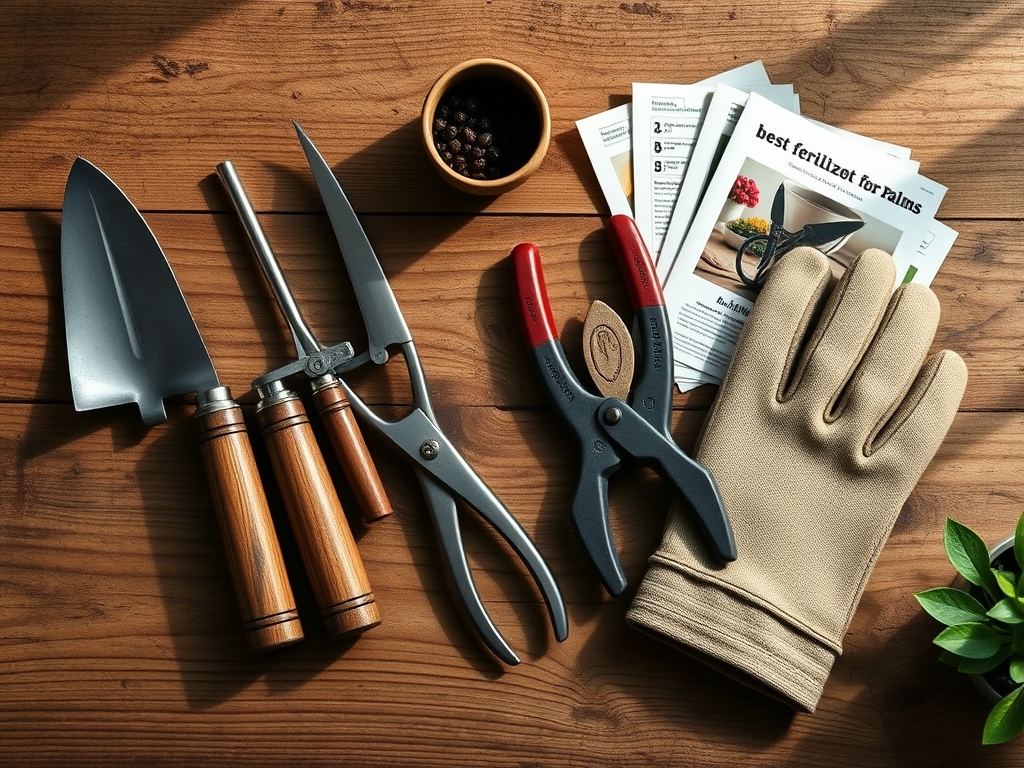
When pruning, use sharp bypass pruners for smaller stems and a hori-hori knife for removing stubborn fiber or small suckers at the base. Never prune "above the horizontal." Only remove fronds that are completely brown and necrotic. Removing green or even yellowing fronds robs the plant of its potassium reserves and reduces its photosynthetic capacity.
The Yield:
For palms that produce edible fruit, such as the Date Palm (Phoenix dactylifera), harvest timing is dictated by sugar concentration. Dates progress through four stages: Kimri (green), Khalal (crisp), Rutab (soft), and Tamr (sun-dried). Harvest at the Tamr stage for maximum shelf life. Use a sharp harvesting sickle to cut the entire fruit cluster. To maintain "day-one" freshness, store the fruit in a low-humidity environment at 32 to 40 degrees Fahrenheit to slow the rate of senescence and prevent fermentation.
FAQ:
What is the best NPK ratio for palms?
The most effective ratio is 8-2-12. This provides high potassium and magnesium levels while keeping phosphorus low, which prevents the interference of micronutrient uptake in most soil types.
How often should I fertilize my palms?
Apply fertilizer three to four times per year during the active growing season. Space applications roughly 90 days apart, starting in early spring and concluding in early autumn before the soil temperature drops.
Can I use all-purpose fertilizer on palms?
No. All-purpose fertilizers often have too much nitrogen and not enough potassium or magnesium. This imbalance leads to nutrient leaching and can cause severe potassium deficiency, eventually killing the palm.
Where exactly do I apply the fertilizer?
Spread the granules evenly across the entire area under the canopy, extending slightly beyond the drip line. Avoid piling fertilizer against the trunk, as this can cause chemical burns and invite pathogens into the stem.